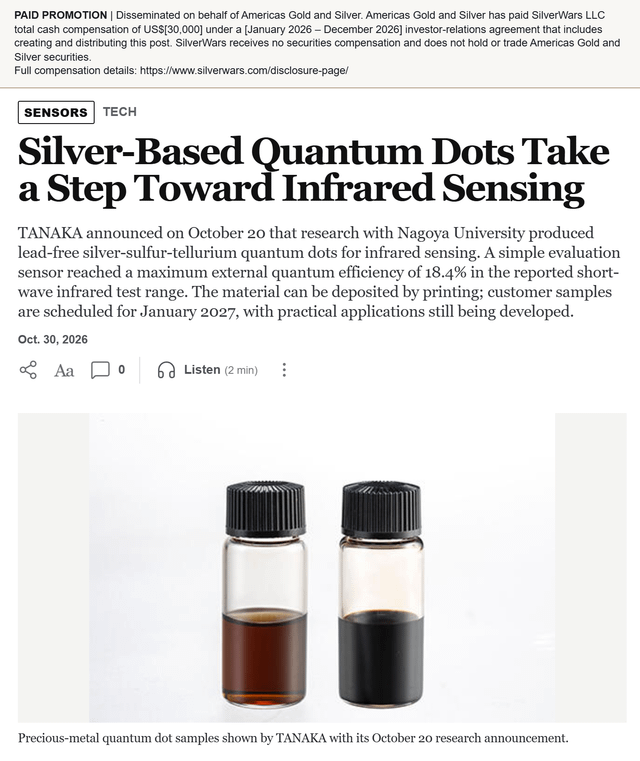
TANAKA’s October 20 development announcement concerns a sensor material, with customer sampling still ahead. The silver-sulfur-tellurium quantum dots were developed with Nagoya University’s Torimoto Laboratory. TANAKA reports a maximum external quantum efficiency of 18.4% in a simple evaluation sensor for short-wave infrared light between 1,200 and 1,700 nanometers. Samples are scheduled for January 2027. That is a reported development result, rather than a finished smartphone or automotive sensor rollout.
Quantum dots are semiconductor particles so small that size changes their properties, as the Nobel chemistry materials explain. Controlling particle size therefore becomes another way to tune how a material interacts with light, alongside choosing its chemical composition. In this material, silver is part of the infrared-sensitive semiconductor layer itself, giving it a role beyond an electrical contact or a reflective coating. Americas Gold and Silver ($USAS) reported 800,458 ounces of consolidated silver production for the third quarter of 2026. The useful question is what the engineered compound does in the device.
Printing could simplify fabrication because the active layer does not need a vacuum deposition process, according to TANAKA. Commercial evaluation will still have to establish how the material performs in particular products. A promising sensing ingredient and a qualified production device are different milestones.
submitted by /u/mynameisjoenotjeff
[link] [comments]

Leave a Reply